Updated August 2026
Updated August 2026
Incorporating your business can open the door to a range of tax and financial planning benefits that other corporate businesses have enjoyed for years. Incorporation is not the right fit for everyone, however, and it comes with important advantages, disadvantages, and planning opportunities that should be weighed carefully before making the decision. The goal of this article is to help you understand the important advantages, disadvantages, and planning opportunities involved with incorporating. This article focuses mainly on the tax aspects of incorporation.
The main benefit of incorporation for a business owner is the tax deferral that arises from the difference between the corporate tax rate and the personal tax rate. Currently, an active business corporation is subject to a combined corporate tax rate of 11.2% in Ontario on its first $500,000 of income starting July 1st, 2026, and 26.5% for each dollar after. In contrast, the highest personal tax rate for individuals in Ontario is 53.53%. Incorporation, in most cases, for a business owner should only be considered when they generate more money than they need to subsidize their family’s personal living expenses and RRSP contributions, if applicable or desired. If every single dollar generated is needed for yearly expenses, then incorporation might not be an appropriate option for tax purposes.
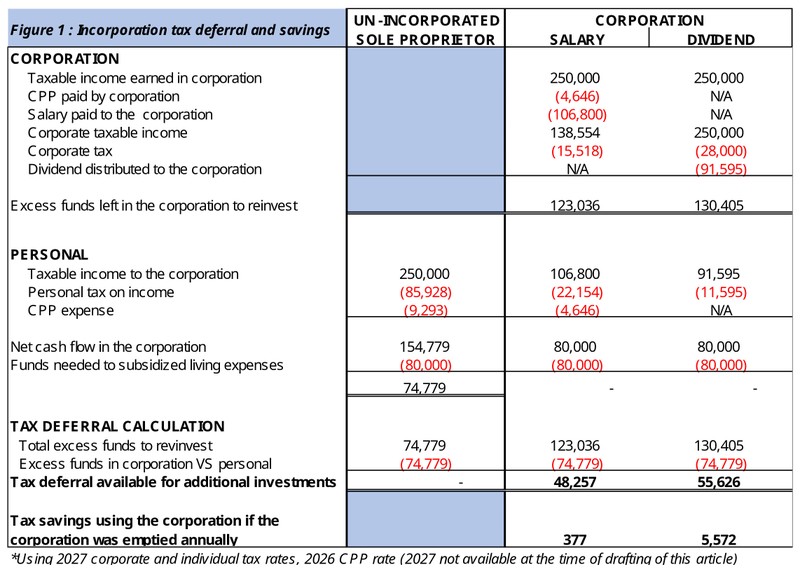
For example, consider a business owner who makes $250,000 a year but only requires $80,000 after taxes to subsidize their living expenses. After paying taxes, that individual would be left with only $74,779 to reinvest. If this same business owner was incorporated, after removing the $80,000 net of tax required for living expenses in the form of either salary or dividends, they would have $123,036 to $130,405 remaining in the corporation to reinvest as they choose. In this case, incorporating the business leads to a deferral of an additional $48,257 to $55,626 annually in excess funds to reinvest in the corporation. Those additional funds can be used for business growth, reserve funds, or additional retirement funding.
Tax deferral can also be useful when income fluctuates from year to year. For example, an unincorporated professional earning $400,000 in year one, $100,000 in year two, and then $400,000 in year three will pay high taxes in years one and three, and less in year two. Previously, there was no option to average the three years for tax purposes. However, if that individual had a corporation, they could decide exactly how much taxable income they want to receive each year, regardless of whether it is a good year or a bad year. This can also create a nest egg by using excess funds retained in the company during stronger years to help during weaker years. This result is attainable because the corporate tax rate is flat at 11.2% within the corporation for the first $500,000 of active income.
One of the key benefits of incorporating is limited liability. In a corporation, liability is generally limited to the assets held within the corporation and does not extend to the shareholders’ personal assets. This means that, in most cases, incorporating can help shield your personal assets, such as your home and personal savings, from the debts and contractual liabilities of the business. It is important to note, however, that there are exceptions, and limited liability does not cover debts you have personally guaranteed. If liability is an important reason to incorporate, further consultation with a lawyer might be warranted.
Shares of a qualifying corporation may qualify for the lifetime capital gains exemption, which is $1,275,000 for 2026. Therefore, if you plan to eventually sell the shares of your corporation, the first $1,275,000 of the sale price can be received tax-free. Depending on your personal marginal tax rates, this could represent a saving of $341,000 in taxes in Ontario based on a sale price of $1,275,000 for the shares. The capital gains exemption can also be multiplied with family members if they are also shareholders in the corporation, either directly or indirectly through the use of a family trust.
One advantage of incorporating is the ability to invest the corporation’s excess funds before they are taxed at personal rates. Rather than drawing all profits out of the corporation, you can retain the after-tax earnings inside the company and invest them.
Examples include: Mutual funds, Stocks, GICs, Rental properties
For those who plan on owning multiple rental properties, seeking additional creditor protection, or wanting to keep the operating company eligible for the capital gains exemption, there is also the option to incorporate a second corporation to act as a holding corporation. The holding corporation would own some shares of the operating company and hold the passive investments. This creates a separation between the active business and the passive investment activities.
Incorporation can offer important tax and planning opportunities, but the right structure depends on your income, business goals and long-term plans.
Initial Set-Up Costs
Potential legal costs, registration expenses and other incorporation-related costs.
Annual Accounting Costs
Annual accounting fees for preparation of the corporate tax return, bookkeeping and financial statements.
Audit Risk
Risk of potential CRA audits.
All of these factors should be considered when deciding if incorporation is the right choice for your business.
As shown in Figure 1, where a business owner earns a net of $250,000 but only requires $80,000 net of taxes to subsidize their living expenses, that same individual can decide to pay themselves either in the form of a salary or a dividend. Figure 1 demonstrates that there would be an overall saving of $7,369 by distributing a dividend instead of a salary to the business owner in order to net out $80,000 after taxes. Of course, other factors must be considered, such as:
The answer is never as simple as the result of the math, but this is a flexibility that is afforded only to those who are incorporated. Those individuals can also control how much money they want to remove year to year from the corporation in order to defer taxes to another fiscal year. It is important to discuss the option of salary and dividend, or a mix of both, with your accountant in order to put forth a good game plan.
A corporation can be structured so that family members, such as a spouse, children, or a family trust, also hold shares. This opens the door to income splitting. Income splitting can be achieved by “sprinkling” dividends to individuals other than the business owner. But in order to do so, certain criteria must be met to avoid what we call tax on split income, or TOSI. If a dividend distributed to a family member falls into the TOSI trap, that dividend would then be taxed at the highest individual marginal tax rate, eliminating the benefit of income splitting.
20 Hours Per Week
A family member who works 20 hours per week for the corporation may be entitled to dividends.
Reasonable Dividend for Work
A reasonable dividend may be declared to a family member in exchange for work contributed to the corporation.
Age 65
Once the owner reaches age 65, the corporation can distribute dividends to the spouse without further restrictions.
There are other ways to have family members receive dividends without having the TOSI rules apply, but these require careful planning and attention to detail.
Conventional retirement planning for business owners would have consisted of maximizing RRSP and TFSA contributions, which have a limit of $33,810 and $7,000 in 2026 respectively, and then investing the rest in unregistered investments that are fully taxable. When you are incorporated, you have the flexibility to start investing by using the corporation as an investment vehicle instead of having personal unregistered investments. Keep in mind, in our earlier example, the business owner who only needed $80,000 net of taxes for their living expenses had an excess between $123,036 and $130,405 in the corporation to reinvest, whereas they would have only $74,779 if not incorporated. This allows them $48,257 to $55,626 more money to reinvest in what could be a retirement fund, and then use those funds to grow every year and only remove them later in retirement. A corporation means having the option and flexibility of having investments in RRSP, TFSA, and in a corporation as an investment vehicle. It also creates the option of using the corporation or a holding corporation to hold rental property investments.
Appropriate planning is required to decide on the proper mix of RRSP, TFSA and corporate investments or rental investments. For some, a corporate investment is a better option than RRSP and TFSA. Others will want to contribute the maximum to RRSP and TFSA while leaving the excess in the corporation to reinvest and grow. Every situation is different and unique and needs to be properly analyzed. There are also specific types of investments that should be prioritized inside a corporation rather than in RRSP and TFSA, and vice versa.
Owning life insurance is an important part of any proper family and estate planning. As an incorporated business, you have the option of having the corporation own the life insurance policy and having the corporation be the beneficiary of the policy, compared to owning the policy personally and having family members as beneficiaries. Life insurance payments, in most cases, are not deductible in the corporation, in the same way as they are not deductible on a personal tax return. However, since the corporation is taxed at a lower tax bracket, it is often much cheaper to own the policy through the corporation. For example, consider a policy that costs $10,000 per year for a business owner at a marginal tax bracket of 40% or at their corporate tax rate of 11.2%. That individual will require $16,667 of personal income to pay the annual personal life insurance policy of $10,000. The corporation requires only $11,261 to pay for that same policy. Therefore, there would be a yearly saving of $5,406 in cash flow to finance the same policy.
BUSINESS INCORPORATION
If you are considering incorporating your business, we can help you evaluate the tax and planning opportunities involved and determine the structure that best fits your needs.
Contact Robert CPA →