Holding corporations have been a staple in corporate organization charts for a long time, whether for asset protection, wealth management, tax planning or other reasons. Because holdings have been around for a long time, and people hear about them in various places, friends, news, the question comes up often: should I have a holding corporation, what is the purpose of a holding corporation, is a holding corporation the right vehicle for me? This is especially true when we start looking at passive investments and how they should be held or protected. The purpose of this article is to explain a bit more about the purpose of a holding corporation, why it might not actually save you any taxes, but might still be a good idea, depending on your situation.
To set the stage, a holding or a “holdco” is not a mythical type of corporation; it is like any other corporation, but we give it the “holding” or “holdco” label to help identify what that corporation’s purpose will be. Accountants and lawyers usually refer to a holding as a corporation that will most likely hold investments or rental properties or “passive income,” while an operating corporation or “opco” would be the one running an actual business or earning “active income.” Holding and operating corporations all have the same legal requirements and limitations; they just get nicknames to help quickly explain the purpose of the corporation.
Let’s get going by debunking what many believe to be true, “owning investments in a corporation is cheaper than owning them personally”. The government actively wants to discourage individuals from owning any passive investment in a corporation, and would much prefer that it be held personally. The taxation of investment reflects this in many different ways, and the main way it does that is by imposing different types of “refundable taxes” such as part of Part I tax and Part IV tax. In other words, the corporation holding the investment is taxed an additional amount because it earned investment income. Part of that tax will then become refundable once a dividend is declared and paid to an individual, thereby transferring the tax burden from the corporation to the individual. My objective is not to go into great detail on how investment taxation works, but it is important to understand the basics in order to make an informed decision.
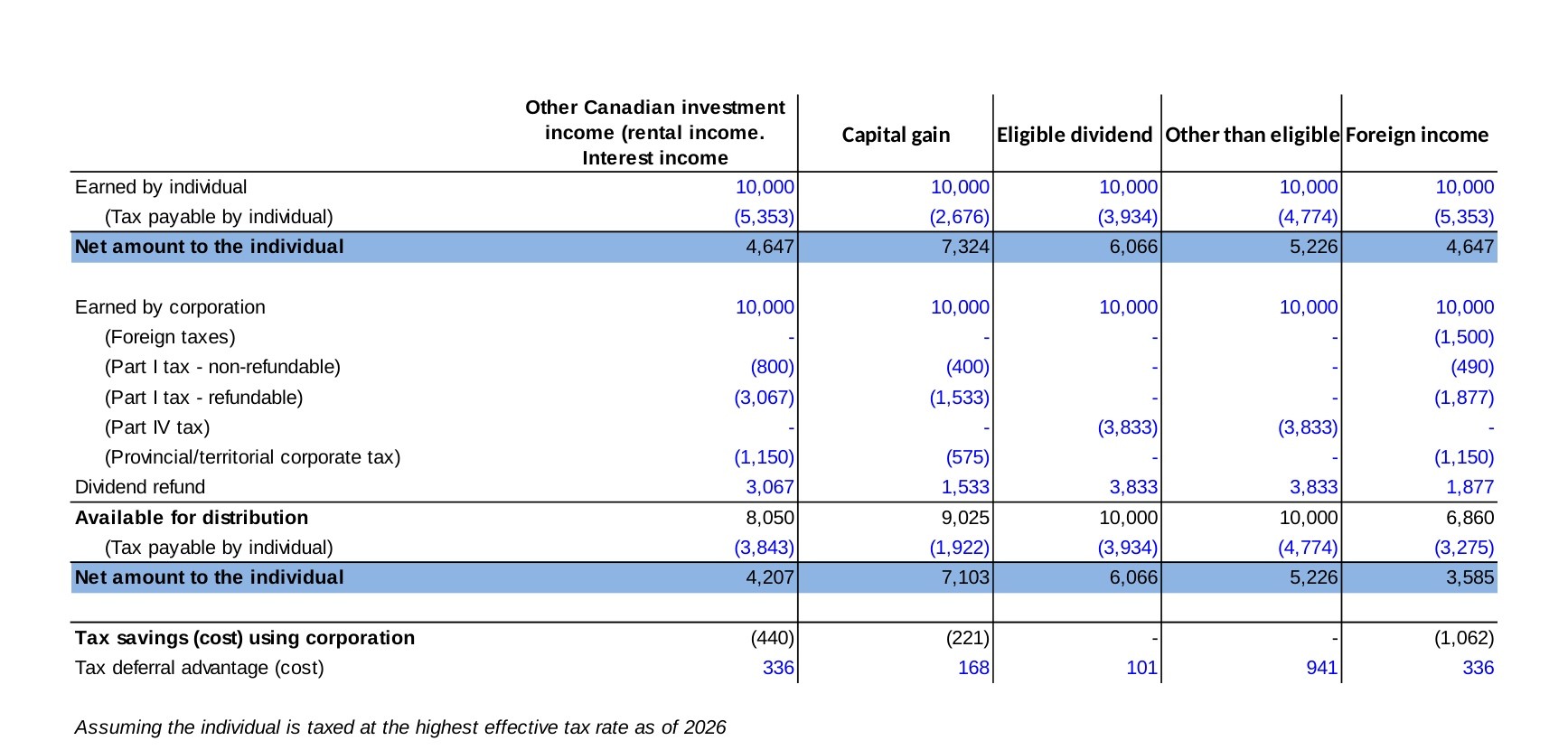
In the first comparison, we look at an individual taxed at the highest Ontario tax rate of 53.53% earning five different types of investment income. The table compares the total tax burden and the amount of cash left when the investment is held in a corporation versus personally. The important takeaway is that none of the scenarios produces an overall tax saving from holding the investment corporately. In fact, all but dividends show an additional cost from earning the income inside the corporation.
Consider $10,000 of net rental income. If the income is earned personally, the individual would pay $5,353 in total taxes, leaving $4,647 after tax. If the same $10,000 is earned inside a corporation, the corporation would initially pay $5,017 in tax. If the corporation is then emptied by paying a taxable dividend, it would receive a $3,067 refund, leaving an $8,050 dividend available to distribute. That dividend would then be taxed personally at a cost of another $3,843, leaving the shareholder with $4,207. Compared with earning the income personally, the corporate structure results in an additional $440 of tax in this example. There can still be a small tax deferral. If the individual does not need the rental income and leaves the money inside the corporation, the immediate corporate tax burden is $5,017, compared with $5,353 personally, resulting in a $336 tax deferral.
The previous example represents the textbook comparison we often see between earning investment income corporately and personally. But most Canadians are not in the highest marginal tax bracket of 53.53%. If instead we use a more modest personal tax rate of 31.48%, roughly equivalent to someone earning around a $100,000 salary in Ontario, and then add another $10,000 of investment income, the results change considerably.
This is quite telling: in each and every type of investment income, the cost of earning the income in the corporation is much higher than in our first example, and there is no tax deferral advantage anymore.
This helps demonstrate an important distinction between corporate taxation and personal taxation. Corporate investment income is generally taxed at a flat rate. Personal taxation, however, is progressive. That means the tax rate applied to an individual’s first dollar of income is different from the rate applied to their last dollar earned.
Specific to rental income, it is important to note that a rental loss inside a corporation can only be carried back against income earned in the previous three years or carried forward for twenty years. That means if a rental project runs at a loss for several years, those losses could remain trapped inside the corporation. By contrast, rental losses generated personally may be deductible against other sources of income, such as employment income.
Now that we have a better understanding of how investment income is taxed, we can look at two common situations where someone might consider incorporating a holding corporation.
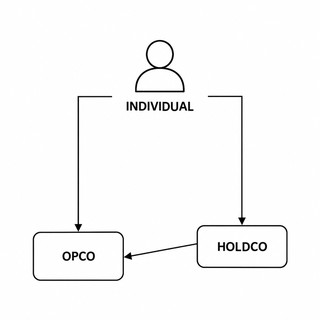
In this situation, we assume that an operating corporation is generating excess funds that the owner wants to reinvest into passive investments. This creates a potential reason to add a holding corporation.It is important to remember, however, that investments held inside either an operating corporation or a holding corporation are taxed in the same general way.
Investments might be taxed more in a holding corporation, or any corporation, than personally, as we saw in our earlier example, but the good news is that the same investment will be much cheaper to purchase or finance than it would have been personally. With some exceptions, an active corporation in Ontario, as of July 1, 2026, will pay either 11.2% on its first $500,000 of net income, or 26.5% for anything above that.
If an individual at the highest Ontario personal tax bracket of 53.53% needs $100,000 for a rental property down payment, they would need to earn $215,192 of income in order to have $100,000 remaining after tax. If the same down payment is funded using retained earnings inside a corporation taxed at 11.2%, only $112,612 of after-tax corporate income would be required. If taxed at the 26.5% general corporate rate, $136,054 would be required. That creates a significant difference in the amount of income required to make the same investment.

If the individual were instead taxed at a 31.48% personal tax rate, it would still require $145,942 before tax to save $100,000 personally, compared with $112,612 inside the corporation. Therefore, paying somewhat more tax on the investment income each year may be acceptable when compared with the significant initial advantage of being able to fund the investment with corporate retained earnings.
Retained earnings that accumulate inside an active operating corporation are exposed to that business’s creditors and potential lawsuits. By paying those excess funds up to a holding corporation as tax-free intercorporate dividends, accumulated wealth can be moved out of the operating company and away from the risks of the active business while remaining inside the corporate group. The holding corporation becomes a safer place to accumulate investments, insulated from the day-to-day liabilities of the operating business. If liability is a major concern, the structure should be reviewed with both an accountant and a lawyer.
If you own an operating corporation and believe you may eventually sell the shares of that corporation, the first $1,275,000 in 2026 may qualify for the capital gains exemption. To qualify for the lifetime capital gains exemption on a future sale, the operating company must meet strict tests. Broadly speaking, substantially all of its assets must be used in an active business. As the company accumulates excess cash and passive investments, it risks becoming “offside” and losing eligibility. A holding corporation can help by allowing excess cash to be moved out of the operating company, helping keep the operating company “pure” and preserving access to the exemption.
The trade-off of having a holding corporation is the added cost and complexity of maintaining a second corporation.
This includes:
Related corporations must also share the single $500,000 small-business limit, so adding corporations to a group does not multiply access to the lower rate. Recent changes have also made it possible for too much investment income to affect access to the small-business tax rate of 11.2%. Each situation needs to be reviewed individually to determine how these rules affect the structure.

A holding corporation can provide valuable planning opportunities, but whether it makes sense depends on your business, investments, risks and long-term goals.
If you are a salaried employee, a retiree, or otherwise have no operating company, and you are thinking about buying rental properties or holding investments inside a corporation, the tax answer is usually disappointing, as we showed in the earlier section. On its own, a holding corporation rarely saves any tax on passive income, and it often costs a little more once you add the legal and accounting bills. That said, there are non-tax reasons a corporation can still make sense.
Holding rental properties inside a corporation puts a legal wall between those properties and your personal assets. If a tenant is injured, a contractor sues, or a property runs into financial trouble, the claim is generally against the corporation and the assets it holds, not against your home, your savings, or your other investments. This protection isn’t absolute: lenders will almost always ask you to personally guarantee the mortgage, so you stay on the hook for the financing itself. It’s also worth remembering that holding several properties in one corporation exposes all of them to a claim arising from any one of them. Where the numbers justify it, some investors use a separate corporation for each big project.
A corporation is a clean vehicle when more than one person is involved, or when you plan to hold several properties. Ownership is represented by shares rather than by names on title. That makes it far simpler to set out each person’s stake, share profits, and bring partners or family members in or out over time, you just transfer shares instead of re-registering title on every property. You can also use different classes of shares to give participants different rights to income and growth. For a single property held on your own, this flexibility rarely justifies the cost; but as the number of properties or owners grows, a single corporate structure becomes much easier to manage than a web of personal co-ownership.
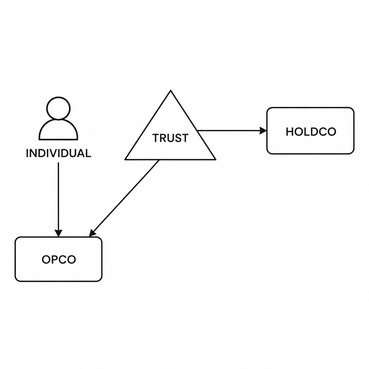
A corporation creates estate-planning opportunities that can be difficult to replicate personally. For example, an estate freeze can be used to lock in the current value of the owner’s holdings while directing future growth to the next generation or to a family trust. This can help reduce the tax payable on death and support an orderly succession. Holding properties corporately can also make it easier to involve a family trust, potentially multiply access to the capital gains exemption if the activity eventually grows into an active real estate business, and keep the enterprise intact as it passes between generations. For most salaried investors, however, the added cost is only worthwhile when one or more of these planning factors genuinely applies. The tax math alone generally does not favour holding rental properties inside a corporation.
There is no one-size-fits-all structure that applies to every situation. Each scenario requires careful consideration of:
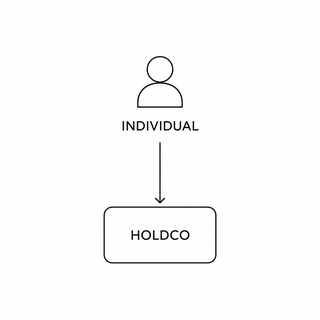
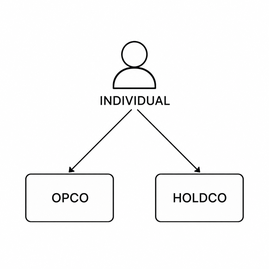
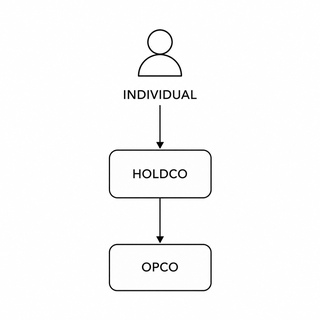
If you are considering a holding corporation, we can help you determine how it should fit into your business, investment and long-term planning strategy.